

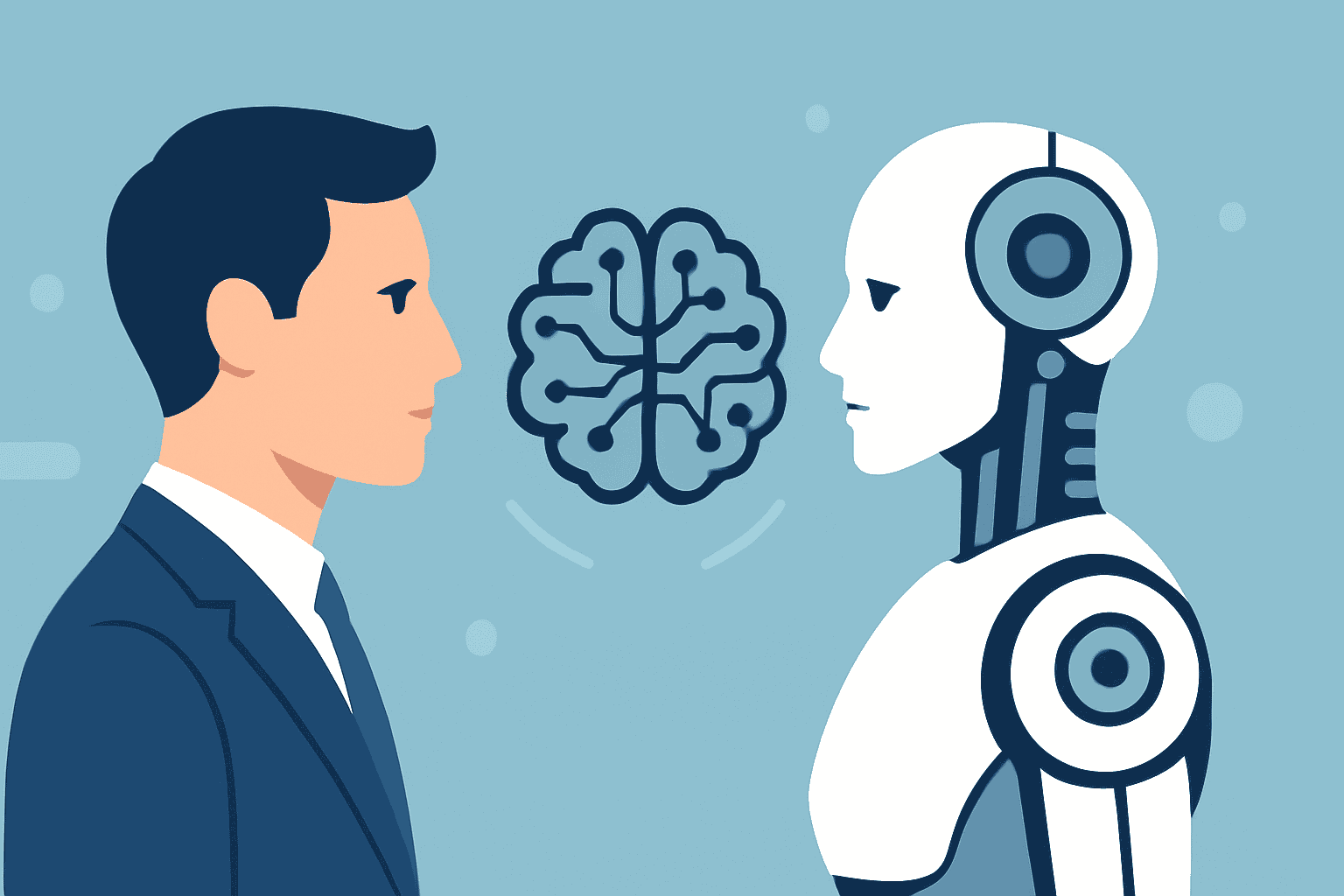
Can AI replace humans? This question is everywhere today, especially now that AI tools can write text Create images, build websites, and even make business decisions.
And honestly, the speed at which AI is growing feels exciting — and a little scary too. But before we jump to conclusions, it’s important to understand what AI can and cannot do.
Because the truth is, AI is powerful, but human intelligence is something far deeper and more meaningful.
In this blog, we’ll break everything down in simple, clear language how AI works, where it can help us, where it fails, and why human creativity, emotion, and intuition still matter more than ever.
If you want a real, honest, and easy-to-understand answer, stick with this till the end. You’ll walk away with a clear picture of the future of humans and AI, and why the smartest path forward is not fear — but collaboration.
What Exactly Is Artificial Intelligence? (AI)
Artificial Intelligence, or AI, is a technology that helps machines perform tasks that normally need human intelligence.
These tasks include recognising patterns, making decisions, analysing data, and understanding natural language.
AI works through machine learning algorithms, which means the system improves as it receives more data.
AI has been around for many years, but only recently tools like ChatGPT, Midjourney and Whisper AI have made it easy for everyone to use.
Today, AI can write text, create images, build websites, analyse trends, and even support decision-making.
AI is powerful, but it is not the same as human intelligence, which includes emotion, creativity, and intuition.
How AI Works: The Logic Behind Machine Intelligence
AI works by learning from data. When you give a machine thousands of examples, it identifies patterns and uses them to make predictions. This is called machine learning.
For example:
- AI reads millions of sentences → learns how language works
- AI analyses large numbers of images → learns to recognise objects
But AI cannot understand life the way humans do. It does not have emotions, experiences, or intuition. Its decisions come from data, not from personal judgement.
This difference matters when talking about “Can AI replace humans ?” because machines follow rules, but humans make decisions using logic, feelings, and real-world understanding.
The Current Capabilities of AI in the Real World
AI is already transforming major industries. It can help in:
- Healthcare – spotting diseases faster than humans
- Finance – detecting fraud and improving predictions
- Retail – understanding buying patterns
- Transportation – helping build safer self-driving systems
AI can handle repetitive tasks, analyse big data, and generate quick results. This makes it a strong tool for boosting productivity and accuracy.
But even with all this progress, AI still relies on human oversight, human creativity, and human problem-solving skills.
The Limitations That Prevent AI from Replacing Humans
Even though AI is powerful, it has clear limits.
1. AI is only as good as the data
If the data is biased, incomplete, or incorrect, the AI results will also be flawed.
2. AI lacks true creativity
AI can remix existing information, but it cannot bring original ideas driven by imagination and inspiration. True creativity is a human ability.
3. AI has no emotional intelligence
AI can detect emotions in text or faces, but it does not feel.
It cannot understand:
- empathy
- relationships
- human behaviour
- social values
Roles that require emotional depth — like teachers, doctors, or business leaders — cannot be replaced by AI.
4. AI cannot think outside the box
AI follows patterns. Humans create new patterns. This is the biggest reason AI cannot replace human intelligence.
Why Human Creativity and Emotion Still Matter
Humans bring intuition, empathy, creativity, and judgement — qualities AI cannot replicate.
We imagine, dream, innovate, and make emotional choices. This human touch is essential in:
- storytelling
- leadership
- design
- strategic planning
- teaching
- healthcare
- problem-solving
AI can support these professions, but it cannot lead them alone.
This is why AI vs human capabilities will always be different. AI is a tool; humans are the thinkers.
The Potential of AI to Transform Industries
Even with limitations, AI has huge potential. Thought leaders like Andrew Ng say AI will reshape almost every major industry.
AI can:
- analyse huge data sets
- improve decision-making
- predict future trends
- reduce human errors
- increase efficiency
- automate repetitive tasks
This frees humans to focus on creativity, innovation, and strategic thinking — areas where humans are unbeatable.
AI will not replace humans, but humans who use AI will replace humans who don’t.
Human–AI Collaboration: The Smart Way Forward
The future is not AI vs humans — it’s AI with humans.
This combination is powerful because:
- Humans offer creativity + intuition
- AI offers speed + accuracy
Together, they increase productivity and lead to better results. Many organisations are already using AI-powered decision-making to improve their services while still relying on humans for final judgement.
This balance is the foundation of a healthy AI future.
Ethical and Social Concerns About AI Replacing Jobs
AI will automate many repetitive tasks, which may affect some jobs. But it will also create new roles in:
- AI safety
- AI strategy
- data analysis
- automation engineering
- digital transformation
The real challenge is not “AI replacing humans” but “humans learning how to use AI.”
Ethics, transparency, and responsible use are important to ensure AI benefits everyone.
The Future of AI and Human Intelligence Together
AI will continue to grow, learn, and become more advanced. But there will always be areas where human intelligence is needed:
- emotional understanding
- imagination
- creative thinking
- leadership
- moral decision-making
- social interaction
Doctors, teachers, HR leaders, designers, writers, and business strategists will always need human insight. AI will act as a partner, not a replacement.
The strongest future is one where humans use AI to become smarter, faster, and more productive.
How Businesses Can Begin an End-to-End AI Transformation
For organisations, the best way to start using AI is through an end-to-end AI strategy. This includes:
- Auditing current AI capabilities
- Understanding AI vs human capabilities
- Identifying the right AI use cases
- Building and deploying AI solutions
- Testing, improving, and maintaining AI systems
With the right plan, AI becomes a powerful tool that boosts growth, productivity, and competitiveness.